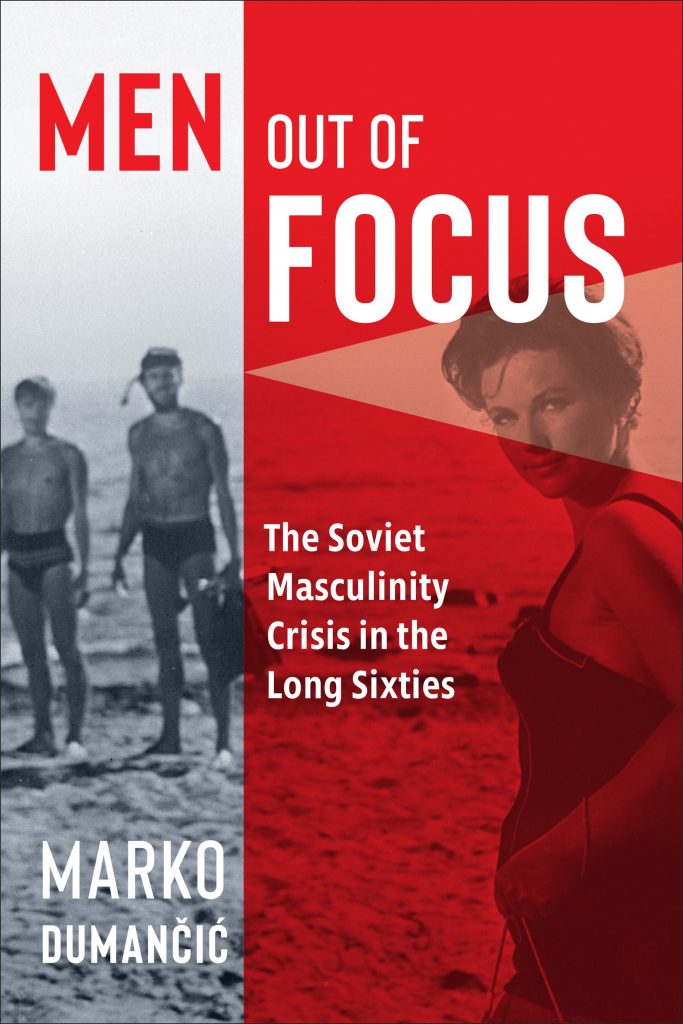
Josh’s post got me thinking about my disinclination to more directly acknowledge the connection between the Cold War and Soviet masculinity – esp. given that it’s (implicitly) present in the book. The Cold War is relevant to this book because it influenced the logic of the period and gave the impetus for the various modernization reforms the USSR pursued. The nuclear race, the Virgin Lands campaign, the space race, and the revival of light industry were all clearly linked to the superpower contest. But even as the Cold War impacted this period, I think it had less of an immediate and intimate influence on the thinking of everyday Soviet citizens—at least based on this set of sources. The anxieties and insecurities Soviet protagonists experienced is, I think, more of a product of a postwar moment that was evident across the continent regardless of a country’s superpower status. France, Italy, and Britain all struggled to come to terms with their sudden postwar affluence, their authoritarian/imperial past, and rapidly changing demographics. The call to not only to rebuild but also to reimagine national life after twin evils of totalitarianism and WWII defined the long Sixties. The film characters and their audiences did not speak in the language of the Cold War; rather, they talked about issues “closer to home” that were results of marriage laws, consumerist policies, de-Stalinization, and (sub)urban renewal. For instance, the stories of celluloid Cold War nuclear scientists were ultimately about maintaining their integrity and dignity in a system run by their country’s bureaucrats. On the other side of the spectrum were scientists who created their versions of robotic Frankensteins and learned that they shortcut their humanity at their own peril. The lesson these scientist learned were about romance and the dangers of red tape and in this way scientists, as men, were no different than men who tried to figure out how to become adequate father figures or men who tried to avoid the discreet charms of the bourgeoisie. The title of the book centers the masculinity crisis of the Sixties, even as the Cold War certainly shaped the terrain of this period.
Robert’s provocative post helped me recall his excellent book Cold War Femme: Lesbianism, National Identity, and Hollywood Cinema. In it, Robert demonstrates how the Cold War transformed the understanding of lesbianism in the US. Whereas in the first half of the twentieth century, lesbianism was seen as a gender inversion (masculine/butch woman), the Cold War context reconfigured the lesbian into a “femme” and lesbianism became more about object choice. The lesbian had gone “incognito” and was tougher to identify. My working hypothesis was that this Cold War transformation did not take place in the USSR precisely because of the postwar masculinity crisis. To compensate for the masculine lack, women had to firmly occupy traditional and stereotypical female spaces – and then some.
In the hopes of generating some more discussion, I thought I’d interject briefly as the facilitator of this conversation to follow up on a thread raised by Marko and our panelists in the hopes that they (and any of our readers) may want to respond.
Now that I’ve officially embarked on a study of the overall weirdness of temporality in the post -Soviet era , thinking about Men Out of Focus makes me feel strangely unstuck in time. After all, this is the book I really wish I could have cited when I was writing my dissertation thirty years ago. Perhaps the next frontier in digital humanities could involve rocketing manuscripts into the past. Is that really too much to ask?
I’d like to start by saying that Erica’s Military Masculinity and Postwar Recovery in the Soviet Union is a masterful monograph that I read and re-read as I finalized Men Out of Focus because it was revelatory for me. It dazzlingly unpacks the intentional project of restoring the spirit of martial masculinity following WWII. Although war does not loom large in my analysis, I imagine Military Masculinity and Men Out of Focus being complementary in that both identify the ways in which significant postwar shifts disrupted the Soviet interwar and wartime gender order. For instance, Erica’s keen observation that reconnecting masculinity and military service was, in part, a (by)product of the fact that the USSR had demographically become “a country of women” and that “the growing plurality in postwar society increasingly offered young men the option of locating their identities in nonmartial categories.” It seems to me that both our works identify if not a crisis, then certainly an anxiety about a kind of misalignment of men’s “proper” postwar role(s). I wholeheartedly agree with Erica’s claim that ever since the Civil War the image of the Red Army serviceman remained central and loomed large in Soviet culture. At the same time, the Cold War competition was as much about beating the US in the production of meat and milk as it was about military supremacy. Perhaps Erica’s focus on the legacy of WWII and my focus on non-military gendered sites meets in the Virgin Lands campaign, which is framed as the postwar generation’s crucible but is more about “bread and butter” issues than about defense and battle-readiness.
As we discuss the topic of martial masculinity, I was reminded during my conversation with Sean Guillory that the Cold War (much like WWII) does not define the story I tell. I certainly looked for the connection between masculinity and the superpower conflict, but it remained elusive for me. Erica’s research (especially Part II of Military Masculinity) persuasively shows the tangible connections between the Cold War rivalry and constructions of masculinity. My sources, however, are strangely mum on the Cold War. There’s certainly plenty of references about “foreign and alien” ideologies and anti-capitalist sentiments, but the Cold War as a measure of Soviet men’s worth as men did not materialize in my research. I hypothesized that this silence was, in part, because of the regime’s investment in peaceful coexistence and détente as foreign policy principles (which are expertly traced in chapter three of Erica’s book).
Finally, Erica’s “crisis for whom” question is brilliantly on point. It seems to me that it is a crisis for the gender project Lenin articulated when he demanded the “old Oblomov” has remained and when he insisted that “for a long while yet he will have to be washed, cleaned, shaken and thrashed if something is to come of him.” Similarly, it is a crisis for the gender project Stalin continued by rejecting the idea of Hamlet as an overly cerebral and indecisive anti-hero. It is perhaps this same crisis point that focused the Soviet’s military attention on “making men out of boys” in the postwar period?
The question of how to determine the political significance of alternative models of masculinity, especially when they are anchored in normatively raced, classed, and sexed bodies, has long been central to queer studies, the field in which I work. Marko Dumancic’s richly textured analysis of the crisis of masculinity that emerged in the Soviet Union during the Khrushchev era suggests why this question is not always easy to answer. In riveting and meticulous detail, Marko traces how Thaw-era filmmakers’ rejection of the heroic masculinity celebrated in the social realist cinema of an earlier era threatened to undermine the Communist Party’s authority.
After the year we have all had, kicking off the summer by reading and thinking about Soviet masculinities feels, to me, like a comforting return to normalcy. It is a topic I began researching and writing about as a graduate student over two decades ago now (good grief!) I was fascinated in the late 1990s by research on machismo coming out of Latin American history and on men of the Victorian public sphere in British history. By 2002, Imperial Russian and Soviet history had its own pioneering volume of essays on masculinities (Russian Masculinities in History and Culture, ed. Clements, Friedman, and Healey), and the field has only expanded from there.
It has been a while since our last book conversation here on the Russian History Blog, so the pressure was on to emerge from our pandemic cocoons with style. We can think of no better volume to do this with than Marko Dumančić’s wonderful Men Out of Focus: The Soviet Masculinity Crisis in the Long Sixties (University of Toronto Press, 2021). As someone with a deep interest both in gender history and in late Soviet culture, I was particularly eager to get my hands on this book and to talk with others about it. I’m looking forward to a vibrant conversation over the next few days. Please read on to find out more about the book and about our panelists!
This blog post is inspired by petty anger. In this deeply weird and unsettling time, I am, like virtually everyone, staying at home. I am in almost every way lucky—I have a job (though hoo boy do I sometimes wish I had listened to my gut and not said yes to being department chair), I have a comfortable home, our restrictions are not too extreme. I live alone, which on balance right now feels like probably also a lucky thing, though it has its own stresses and sources of sadness. I’ve in particular come to rely on a daily walk to get out into the air, to stretch my legs, to try to turn off from all the stresses of my job right now.
Image of a bicycle from B. Kaul’fus, Kratkoe rukovodstvo k izucheniiu ezdy na velocipede i obrashcheiiu svelosipedami fabric Adamants Opelia v Riussel’sgeime (Kiev, 1893)
On these walks, though, I often find myself seething with rage at the pettiest of things—people who do not keep to the right while walking or riding or running. Even in a time of social distancing, my rage feels out of proportion to the offense. But then I remembered a letter of complaint I came across in one of my beloved files of random correspondence from the Gatchina Palace administration.
To His Excellency, the Director of the Gatchina Palace Administration
Riding yesterday, the 3rd of August, at 9 in the evening, on a bicycle, in the Imperial Priorate Park, I came upon a gentleman unknown to me, driving a white trotter at full speed, who, despite my increasingly ringing my bell, continued to ride on the left side of the road, as a result of which I, at risk of being trampled, was forced to jump down from my bicycle onto the grass; at my comment, made in the most polite form, that one should drive on the right side, the gentleman sitting in the charabanc and driving the horse answered me with unacceptable obscenity. On my way back, about twenty minutes later, I had the misfortune to again come across this same gentleman, continuing as before to drive on the left side of the road; in response to my bell and to my comment that besides the existing rule to drive on the right side, even only politeness demands that one should give way, the gentleman informed me that such a rule does not exist, having added along with this message personally to me insulting expressions so impolite, that repeating them word for word in the present letter I consider impossible; in the end of all of this insulting actions were threatened. Of all of this I immediately gave a report to the duty officer of the Gatchina Police. [Hearing] my description of the characteristics of the horse and the gentleman, the Police officers sitting in the duty room recognized the owner of the horse as Gatchina homeowner Bronislav Liudvigovich Adamovich; in order to definitively establish the identity of the culprit, I gave the Police a detailed description.
Having in mind that a simple monetary penalty such as laying a fine by judicial process will hardly guarantee that the public visiting the Imperial Priorate Park [will not be bothered by] a repetition of such misconduct on the part of the above mentioned gentleman, [misconduct that] violates social morality and order in the Imperial park, and that the insult given by him to me was without any reason on my part, I have the honor to present all above noted to the discretion and resultant decision of Your Excellence, humbly asking that you inform me of what is done about this matter.
Collegiate Secretary
Feodor Feodorovich Rein.
4 August 1892
Someone looked into the matter the day it was sent, and noted down the following report:
Feodor Feodorovich Rein, Collegiate Secretary, works as a Secretary of the Main Military-Sanitary Committee of the Ministry of War. Residence: in the town of Gatchina, on Baggovutovskaia ulitsa, no. 46, the home of engineer Rein.
I have the honor to report … that in the matter of the offenses committed in the Priorate Park by nobleman Bronislav Liudvigovich Adamovich to Collegiate Secretary Fedor Fedorovich Rein, a witness statement by Luga meshchanin Artur Karlov Reikhenberg, residing in the village Bol’shaia Zagvozdka, Gatchina township, explains that it was completely possible for Rein to pass without obstruction along the road on the right side, and beside that it is necessary for all bicyclists to pull over and get off their bicycles when they meet people riding on horses in light of the fact that every horse seeing the unfamiliar sight of a bicycle without fail begins to buck and to shy and in general to sidle, so for Rein to be offended by Adamovich there is no foundation, all the more so because, as Reikhenberg reports, Rein was the first to address Adamovich in rude form, with the comment “you do not know how you should drive, why don’t you keep to the right side,” but all the same from my point of view Adamovich should be given proper warning that he should drive more calmly, and that if there is a second complaint about him driving quickly and not following the general rules of driving, then he will be prohibited from driving in the Priorate Park forever and for reckless driving in general he will face legal liability.
I’m not going to try to spin this out too much—of course there’s plenty of stuff to say about these figures ad who they might be, or of the fact that Mr. Rein was a thoroughly modern man on his bicycle in 1892. Perhaps I’ll come back to them in another post at some point. But I copied this all out because I thought it was sort of funny, and I loved the resonance of the idea of bicyclists and drivers at odds over road usage, because that’s still such a present part of urban discourse.
Now, though, I’m struck by the anger. The anger that seemed to motivate Rein—if Reikhenberg was right and he really did have enough space, his action to jump down into the grass feels like a bit of a conscious display of being inconvenienced for the sake of show, rather than anything real—the anger he received in return—although Reikhenberg reported that Rein was the first person to be rude, his reported statement (which, I should note, used the proper vy, not the familiar and potentially offensive ty) hardly seems to be enough to cause someone to respond with obscenity.
in 1892 Gatchina was a bustling place, with Alexander III often in residence (though probably not in August) and its two railway lines making it an increasingly desirable suburban residence for people who worked in St. Petersburg. The park might simply have been busier than normal with summer dacha residents, making the whole exercise of bicycling or driving more frustrating. I suppose one could also make a case that the quickness to anger on the part of these men reflects the internal opposition they might have felt about their own status as modern men—one a nobleman (probably a Polish nobleman) with a fancy horse, one with cutting edge bicycle—in an anti-modern system, an anti-modern system that could not be ignored at that time and in that place because it was centered on the palace next to the park.
And then I think about my own petty anger, and wonder about which of the many background worries we all face right now that is manifesting itself in those feelings of rage.
(Sources: RGIA f. 491, op. 3, d. 386, ll. 311-312ob.)
Sister of Mercy working at beginning of World War I (Photo: Florence Farmborough)
Judging by my social media feed, several folks with an
interest in Russian history have been asking themselves “Hmm, I wonder what
happened in Russia during the 1918 global influenza pandemic?” Many moons ago,
when researching medical care and medical personnel during World War I for my
book Imperial Apocalypse, I had the same question. At that time, I found
very little work on the question, either in English or in Russian, though I may
have missed something then or something might have been published more
recently. (And if there is something out there, please reach out and let me
know. I’m interested!)
I did some archival research on this question, though it was
limited both by the fact that the flu struck right after the period (summer of
1918) at which I was wrapping up my story and by the scattered nature of some
of this material. As is often the case, much of the research I did ended up on
the cutting room floor, and I had only a couple of sentences in Imperial
Apocalypse that dealt with it:
“As 1917 turned to 1918, and then throughout the rest of the Civil War, the Whites, Reds, and warlords all failed to create the conditions of state support and personal security necessary for vibrant economic institutions to re-emerge. People were hungry and cold. Then, increasingly, they starved and froze to death. As they weakened, they sickened further. Each month saw an increase in the number of people hospitalized, and epidemic diseases became more prevalent. In the summer of 1918, cholera ripped through cities like Iaroslavl. By October, the global influenza pandemic was hitting other towns in the Golden Ring like Rybinsk and the Soviet leadership in the Kremlin alike. Many Russians no sooner recovered from one disease than the next one struck.” (p. 256)
My mention of Rybinsk, a town just north of Iaroslavl, was of course not accidental. One of the sources I found was a set of records from a “flying detachment of the Red Cross for the fight against epidemics in the city of Rybinsk” from the summer and fall of 1918. (GARF f. R-4094 op. 1 d. 137). I entered these data into a spreadsheet to see the ways that disease hit at least one medical facility in at least one city in this critical period. My basic takeaway was that, in Rybinsk at least, the flu was just the latest and not the most lethal of the epidemics to affect the town. The flu first made its appearance into the records in October 1918 as the “Spanish Illness,” though by December it was more correctly labeled as “Influenza.” In October, 17 people were treated, 7 were released, and 10 were still in the clinic. In November, 10 more people became ill, 14 were released, 1 was still in care, and 5 had died. In December, 7 more cases appeared, but by the end of the month all 8 patients had recovered and been released. In sum, then, 34 people in Rybinsk were treated for the flu by this flying detachment, and 5 of them died. This was, of course, terrible. But just before the flu arrived, there had been a cholera epidemic in the city. From July-September, 284 people were treated by the detachment for cholera, with fully half (142) dying of the disease. Earlier still, in May, June, and July, 55 people had gotten typhus, though only one died.
These numbers offer only partial insight into the dynamics
of the epidemic, of course. Epidemics strike unevenly in geographic terms, as
we are currently learning. Was Rybinsk more or less affected than other
regions? These were the records of a single medical detachment. Were there
other medical institutions operating in Rybinsk? If so, did they treat
infectious cases or send them directly to the flying detachment? There is narrative
evidence given by officials in these records that many of the cholera cases
they treated were at death’s door because families tried as much as possible to
care for them at home, often infecting themselves in the process. Did they try
to do the same with the flu? If so, were there many cases unaccounted for
because they got better (or died) without ever seeing a doctor? Did the fact
that many young men (a particularly hard-hit group in this pandemic) were serving
in the military mean that civilian areas saw a lower impact? I don’t know the
answer to any of these questions. All I really feel confident in saying is that
the social and medical impact of the influenza pandemic likely affected Russia
differently than many other areas because of this larger context of mass
epidemics and, even more broadly, of state and social collapse.
One more point of interest is that in November, 1918 a request
was made to a Smolensk clinic to send weekly reports on the “Spanish disease”
both to the oblast department of health and to the regional administration of
the Red Cross. Perhaps at least some of those records survive. Maybe, once our
current pandemic crisis eases, some historian will be able to fill in some of
the many gaps of knowledge we have. In the meantime, stay healthy, my friends!
Amidst all the craziness of this past … forever … I’m pleased to say that the Summer Research Laboratory at Illinois continues strong. We have a great program this coming summer, and excellent fellowship support available for scholars. (In addition to housing and travel grants for up to two weeks work in our fabulous library collections, we are able to offer $1000 grants in support of other expenses.)
So if you have a work you’ve been dying to finish, or are mulling over a new project but haven’t quite been able to lay out a plan, consider joining us! We have everything you need to get things done. The deadline for full consideration is March 15. I’m always happy to answer questions about the program.
In my first blog about the oral history interviews conducted as part of my study of Protestant life in the USSR I wrote about the life of Z. who was born in 1925 on the outskirts of Moscow. She came from a poor background but as a young woman managed to establish a stable life for herself: a good job in a factory, marriage to a foreman. Her religious beliefs – as a young woman in the late 1940s, she was baptised – represented a threat to this steady Soviet life, and were the source of conflict with her husband. The protagonist of this second blog is rather different. In the late 1940s, O. was still a child but she had already been separated from her parents and sent, alone, into exile.
Here is the final post of the semester for the “Anatomy of a Course.” I hope it has been helpful, in whole or in part, for folks in the field. I’ll give the final words to Kamini Masood, a student in the class who wanted to write about the relationship between history and fiction after a stimulating exchange with Steve Norris during his classroom visit in November. Here’s Kamini:
There are countless ways to scare college students away from history classes. One way, as I found out my sophomore year, is to assign Dostoevsky’s Demons. The sheer size of it is enough to send overworked students running for the hills. I know I almost ran.
The final exam serves many functions. It’s a moment of assessment, of course, a relatively important one in this class at 40% of the total grade. A student writes for two hours, and you read it for fifteen minutes. If you do it right, that exchange allows you to determine whether a student has done “satsifactory” (C), “good” (B), or “excellent” (A) work. But what does it mean to “do it right?” I’m pretty sure there’s not a single perfect way to construct a final. In any case, I have experimented with different models over the years: take-home finals, oral finals, and in many courses no final at all. In recent years, however, I’ve adopted a hybrid model that I like for my intermediate “lecture” classes. I give students the long essay questions ahead of time but also have a set of shorter questions that they see for the first time during the exam itself. Here’s the final exam I gave this year:
I’m sitting now proctoring the final exam for “Russia from Lenin to Putin,” so the “Anatomy of a Course” is nearly finished. I’ll have a final post or two on the final exam, and there will be one more guest student post, but before I wrap this series up, I want to speak briefly about co-curricular activities and their place in my course. There were two big events that planning began for in the summer and that were on the syllabus: a roundtable on revolution to commemorate the 100th anniversary of the Russian Revolution and a visit from Steve Norris to talk about blockbuster films and patriotism in the 21st century. Let me talk about the Norris lecture, in part because it occurred more recently (two weeks ago), and in part because of Revolution Anniversary Fatigue.
I have found that outside speakers work better when I consciously and extensively integrate them into my course structure. I will admit to a soft spot for attending lectures that introduce me to something completely new and divorced from what I’m thinking about at a given stage, but I know that not all students feel the same. As I said in an earlier post, inviting Steve allowed me to re-envision what the structure of my class might look like. More specifically, it allowed me (and more importantly my students) to think in terms of iterations and reiterations of historical moments. Most obviously, I had never assigned (or read) Akunin’s Turkish Gambit prior to this semester, but students had this for their summer reading and then returned to it with a required film screening, readings from Steve’s Blockbuster History, and then his talk, all in the same week. Thus, not only did we get to talk about imperialism, nationalism, militaries, police states, and gender politics in the 19th century on the very first day of class by talking about the themes of Turkish Gambit, but we got to return to those important themes in the final days of the course by examining the same “text.” Or mainly the same text, as the film differs in important ways from the novel. Most notably, the “who” in the “whodunit” tale changes (for reasons Steve talks about in his book and discussed with my class). But also, as students and faculty alike noted, both the gender politics and the theme of orientalism changes. Varvara’s character goes from being a woman struggling with the collision between political commitments, gender expectations, and her own desires to a simpering stereotype, and the book’s challenge to orientalist stereotypes ends up with a straightforwardly orientalist movie. These observations allowed students not only to understand Norris’ book (and his excellent updating of these themes to encompass shifts during Putin’s second stint as president), but also to understand what we might mean by the terms “nationalism” and “patriotism” in commercially saturated media environments that both my students and Russian citizens live in today.
Bringing in an outside speaker has additional positive knock-on effects. Many of my students were thrilled to meet the author that they had just been reading. This thrill is easy to forget, especially when we have our cynical moments about our jobs and profession, but it is genuine. We learn because we are human, and combining human contact with the words on a page is powerful. In addition, it allows them (rightly) to feel like they are entering a world of experts. They’ve literally done the reading, and this allows them to ask good questions that engage and excite scholars in the field. Finally, outside speakers help promote faculty cohesion. We’re all busy, and it’s nice to sit down to have dinner with five or six folks, one of them an outsider, and talk about new ideas (and, of course, to compare working conditions and kvetch). In sum, though these events take some work both intellectually and organizationally, the payoff is quite substantial. Many thanks to Steve and to many of my other colleagues and friends who have agreed to come speak at Lafayette in the past!
How should a college professor teach? Pick up a guide for new instructors (or attend a workshop aimed at the same), and you may well be advised to train yourself to be a “guide on the side” rather than a fusty old “sage on the stage.” Don’t worry, this post won’t be a rehashing of the debate between pro-lecture and anti-lecture partisans. No, my point today is that posing the question in the way it has traditionally been posed impoverishes the debate by giving only two options and by presenting those options as mutually exclusive. This is a shame, because none of the many great teachers I have seen in action were either a “sage on the stage” or a “guide on the side.” There are lots of ways to be effective in the classroom, but the folks I’ve seen with the most success have both made their teaching persona an outgrowth of their personalities and have shown flexibility in teaching methods depending on the class they’re teaching. Rendered as pithy advice, this would boil down to “Be yourself” (or, maybe, “Be your best self”) and “Pay close attention to the students in front of you.”
This month, I invited one of my students to write about her experiences in the “Russia from Lenin to Putin” course. She chose to write about how different types of readings worked together in the course. The author is Nicole Harry, who is a History major and a Russian and East European Studies minor with interests in the study of Soviet history and of society and politics in the post-Soviet states. Here’s Nicole:
Every year, somehow, the start of the fall semester gets busier and busier. At an institution like mine, which is crazy about meetings, everyone wants to meet right away. Tenure cases are mulled. Grant proposals are due (hooray for an upcoming sabbatical!) And in the midst of all of this, you teach the first critical weeks of the course. It’s especially tempting (and dangerous) for professors with a few years under their belts to think about putting classes on cruise control, using old texts, old lecture notes, and spending entire periods going over the syllabus.
But you will not get a second chance to make a first impression. Students start answering pressing questions regardless of what your out-of-class workload looks like. Is this course interesting? How much work is there? Do I really have to do all the work? Will I have the chance to contribute/discuss/question in class? The answers, I think, help build attitudes that fall on a spectrum that ranges from “my professor is mailing it in, so will I” to “I’m looking forward to the readings and classes each week.”
It is frustrating, but I think undeniable, that there is no sure recipe for success when it comes to establishing a positive classroom atmosphere. Preparation is critical, but sometimes improvisation matters more. Coming across as serious and disciplined is important, but being open-minded and open-hearted is necessary too. Finally, and probably most importantly, you’re just one human being in that room. You have more influence than anyone else, but sometimes individual students (or small groups of them) either make the class a special and memorable one for all involved or make it a miserable slog.
Despite not having full control over the outcome of the social dynamics of the classroom, I do my best to structure the first weeks to maximize chances for success, with three basic goals in mind. First, I want to “interpellate” every student in an intellectual way. This means learning their names as quickly as possible (which is difficult for someone, like me, who has difficulty linking and remembering names and faces). But it also means providing early opportunities for each student to say (or write) something of substance and to have me respond in a meaningful fashion. Second, I try to lead with interesting classes and topics. As the previous posts indicated, it’s important to design an excellent syllabus, but if the syllabus is the most interesting part of your course, something is probably wrong. Sometimes, this means getting to the heart of the course right away, and sometimes it means designing an interesting introduction. Finally, it’s important to set the core narrative in motion. Courses, like ideas, have shapes. History classes often (though not always) take shape through narrative. We have to decide which ideas/events/notions will form the through line of the course and then get busy introducing and explaining them.
In terms of course readings for “Russia from Lenin to Putin,” I decided to assign summer reading – Boris Akunin’s Turkish Gambit and several of my favorite Chekhov short stories. This accomplished several goals, I think. First, these were interesting readings. Any student unable to appreciate the charms of either Akunin or Chekhov is unlikely to find much else of interest in the course, so s/he will know this in plenty of time to drop the class. Second, the very act of assigning summer reading is an indication of seriousness and commitment – a mutual pact between me and the students that we’re going to work hard for each other. Finally, it sets up for a first day in which we begin by discussing the “woman question” in 19th century Russia and the inversions of anti-Semitism in “Rothschild’s Fiddle.” That was, I promise you, way more engaging than going over penalties for absences and federal credit hour requirements on the syllabus. By the end of the week, we had gotten around to discussing the nuts and bolts on the syllabus (and setting expectations for students), but it didn’t occupy the first moments of the class. Those first discussions were also a source of great relief. Most of the students had not only done the readings but were ready to discuss them and to ask questions about aspects of those texts that confused them. They were curious, energetic, and engaged with each other as well as with me. They are already the kind of class that makes you love your job.
I introduced some new activities when we got to the second day of class. We did two things. I gave my first lecture (on the period from 1905-1914), and we discussed the first chapter of their first long book by a historian, Steve Smith’s Russia in Revolution: An Empire in Crisis, 1890-1928. This was obviously the first time I taught this book (which came out just this year). As I mentioned in an earlier post, I had skimmed it prior to assigning it, but I didn’t know how well it would help me achieve my overall course goals, including the key one of teaching students to think in more complex ways both about class and revolution. I’m happy to report, now that the students and I have read the whole thing carefully, that it works wonderfully. It hits all of the key topics, challenges historical orthodoxies in interesting ways (just yesterday we talked about his careful critique of the idea that control of the Secretariat was the only way that Stalin won the political battles of the 1920s), and represents the Revolution in all of its messy, bloody, inspiring glory. Smith was a thoughtful, clear, and reliable guide for the period leading up to 1928.
We are now well on our way, having finished the fourth week of the course. Students know why workers and soldiers supported the Bolsheviks in 1917 and why so many of them turned away from them later. They know how the fate of the worker revolution actually centered on grain policy and the hunger, violence, and eventually famine that resulted from the increasingly coercive and disastrous policies of successive governments. Class has been described, not so much theoretically (though we did some of that too) as how it actually existed in Revolutionary Russia. It is already clear that the Revolution was fired by deep (and deeply politicized) feelings of social and economic injustice and that the Bolshevik victory in the revolution was at least in part a result of a violently authoritarian streak that would have dire consequences in the years and decades to come. Stalin and Stalinism are on our collective horizons.
This year while I’m on a research fellowship, I’m helping the University of Utah’s Asia Center to organize an interdisciplinary conference. We’re planning it around the theme of “Asia in the Russian Imagination,” but are expecting it to be more broadly concerned with the history of Siberia, Central Asia, and the Russian Far East and North Pacific. The conference will be held at the University of Utah’s campus in Salt Lake City on March 23-24, 2018. Over the past three years, the Asia Center’s “Siberian Initiative” has sponsored talks on anthropology, environmental studies, history, film studies, and linguistics, and we are continuing this interdisciplinary approach to Russia in Asia/Asia in Russia at our conference.
Toward the end of a very long archival file, toward the end of a long research trip, I came across a letter that made me gasp and then tear up as I sat in the reading room. It was sent from the Minister of the Interior to the Minister of the Imperial Court on December 12, 1914, and then forwarded on to the Gatchina town authorities:
On October 26, Iuliia and Luiza Ruprekht, the first 71, and the second 67 years old, German subjects who lived in Gatchina and were subject to deportation due to the war, gave the Gatchina police chief a petition in which they asked to be allowed to remain in their place of residence in Russia, where they were born and had lived all their lives, and referring to their elderly years, illness, and material dependence on their sister, a Russian subject living in Petrograd. [The police chief] presented this petition to the Petrograd governor only after thirteen days, that is on November 8, with а favorable conclusion, due to which [the governor] placed a decision favorable to the petitioners on the report. But not waiting for notice of [the resolution of their petition], the aforementioned foreigners on November 9 ended their lives with suicide, having hanged themselves in their apartment; the reason for their suicide, according to the same police chief, was that they were dejected under the influence of the threat of the possibility of being sent, as German subjects, out of Russia. The police chief’s explanation of why there was such a delay in presenting the late Ruprekhts’ petition to the Petrograd governor does not hold up.
Where to begin? Well, there’s a horrible irony here, because the other actors were hardly themselves all Russians, even if they were all Russian subjects. The police chief’s name was Kavtaradze; the Minister of the Imperial Court’s name was Frederiks, the Petrograd governor’s name Adlerberg. The officials of imperial Russia were of its empire, not all of Russia. I could go on about the unfairness of former non-Russians turning on current non-Russians, particularly current non-Russians who had lived their whole lives in Russia, except that I think that’s not really the story here.